The USA PATRIOT Act is an act signed by George W. Bush after the massive terrorist attack that took place in 2001. The name is an acronym which comes from "Uniting and Strengthening America by Providing Appropriate Tools Required to Intercept and Obstruct Terrorism Act of 2001". It was introduced in order to keep the wrongdoings under control and to stop the crimes before being commited. The most important stipulations are:
1. The Patriot Act allows investigators to use the tools that were already available to investigate organized crime and drug trafficking.
2. The Patriot Act facilitated information sharing and cooperation among government agencies so that they can better "connect the dots."
3. The Patriot Act updated the law to reflect new technologies and new threats.
4. The Patriot Act increased the penalties for those who commit terrorist crimes.
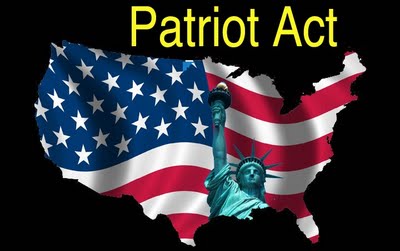
Taking into consideration the fact that the Act violates people's privacy, it is no wonder that a number of Americans doesn't agree with it. The American Civil Liberties Union (ACLU) is one of the organs that represents resistance. The members argue that there is not enough information about what can be done with retrieved data. Moreover, it is not specifically said who is responsible for the performed actions. The case of warrants is also not clarified enough. They can be issued to everyone and the circumstances for receiving one are not as strict as they were before. Generally, the main problem is about the provisions being too broad and, what comes after that, the freedom of an average citizen is considerably reduced.
In my opinion, the Act can do more good than evil. Of course, the opponents have right about some issues and there is no doubt that some changes need to be introduced. The basic problem is that Americans are not informed enough and they simply fear of the unknown. The Internet security is not perfect and while people rebel against the government's actions that are performed for the greater good, they are not even aware that some hackers can have their data without them even knowing.
poniedziałek, 11 stycznia 2016
sobota, 9 stycznia 2016
cute cat theory of digital activism & dancing pigs
Cute cat theory of digital activism - a theory developed by Ethan Zuckerman in 2008. It says that people on the Internet are more likely to use it for entertaining and social reasons than for becoming activists. Cute cat in the very name of this concept refers to all the low-value contents that users are interested in. The cats are present all over the Internet and there is no need to explain it to a person who uses the Internet at least from time to time. Among the most powerful engines that people use for their activities are Facebook, Twitter or Blogspot. On the other hand, such platforms can be used for political and social activism as well. By blocking them and, what comes after that, preventing people from such doings, governments cut off also the innocent 'good' users. The outcome is that it is harder to keep the protesters under control as they use those sites that are not dedicated solely to their needs. The picture may serve as a good example of how it looks like:
Dancing pigs - the term originated by by Edward Felten and Gary McGraw. It is used mostly by IT specialists to describe people's usual behavior on the Internet and their approach to the computer security. Whenever a user wants to visit a webpage or download a picture and, right before that act, sees a security alert, he/she will continue anyway. Dancing pigs is some kind of example in itself - when a person desires to see the dancing pigs, he/she will do it despite all the warnings about it not being safe for the computer. Of course, such reckless behavior may lead to serious damages, data leaks and so on.
Subskrybuj:
Posty (Atom)